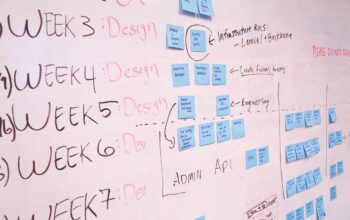
Hook: Imagine a marketing team that cut campaign turnaround from two weeks to two days — without hiring anyone new. That’s what happens when tools, rituals, and people line up around the same goal.
Why this matters right now Teams today juggle hybrid schedules, faster timelines, and more stakeholders than ever. The hottest moves in Team Collaboration aren’t just new apps — they’re small, repeatable practices and real stories of teams getting measurable results.
Trend 1 — Synchronous focus blocks power faster delivery Story: A product design squad at a mid‑sized fintech replaced long email threads with daily 90‑minute “design sprints” on a shared whiteboard; they launched a new onboarding flow in three sprints instead of months.
Why it worked:
- The team used a single visual canvas so everyone saw the same problem at once.
- Short, timeboxed sessions forced decisions and reduced rework.
Quick tip: Try one 60–90 minute focused co‑working block per week with a clear outcome (e.g., prototype, decision, draft).
Trend 2 — Lightweight governance beats heavy process Story: A marketing operations team used a simple three‑status rule on their task board (To Do / In Review / Done) plus a single reviewer for each item; approvals dropped from a week to 48 hours.
Why it worked:
- Reducing options removed paralysis.
- Clear ownership prevented items from lingering in limbo.
Quick tip: Standardize one decision owner per work item and a maximum review time (e.g., 48 hours).
Trend 3 — Document‑first collaboration integrates work and context Story: A customer success group shifted from siloed notes to a shared living playbook where every rep could add a win, a failed approach, or a customer quote; onboarding time for new hires fell by half.
Why it worked:
- Documentation became the team’s memory — context traveled with the work.
- Tags and short templates made contributions low‑friction.
Quick tip: Build one shared doc for a recurring process and ask each person to add one example or lesson every week.
Trend 4 — Tool pairing (one primary + complements) keeps teams nimble Story: A creative agency standardized on a single project board for assignments and used a lightweight review app for proofs; creatives spent less time toggling apps and more time creating, raising billable output by 15%.
Why it worked:
- One source of truth avoided duplicate tracking.
- Purpose‑built tools handled specialized tasks without bloating everyone’s workflow.
Quick tip: Choose one primary tool for task tracking and add one best‑of‑breed app for reviews or whiteboarding — then limit integrations to essentials.
Trend 5 — Human rituals beat feature bloat Story: A remote engineering team instituted weekly “show & tell” demos and a short retro; cross‑team bugs detected earlier, and morale improved because people saw impact beyond their own code.
Why it worked:
- Rituals create predictable touchpoints for alignment.
- Seeing outcomes builds intrinsic motivation and shared ownership.
Quick tip: Start a 20‑minute weekly demo slot where one person shows what they shipped; rotate presenters.
Practical playbook — three steps to start today
- Pick one pain and one metric (e.g., reduce review lag from 5 days to 2).
- Run a two‑week experiment using one of the trends above (timebox, tool pairing, or documentation habit).
- Measure, iterate, and keep only the rituals that move the metric.
Voices from the field (expert attribution style)
- A head of product I spoke with called short, visual co‑working “the difference between noise and clarity.”
- A people ops lead said: “We stopped chasing the latest app and focused on one shared cadence — and people stopped asking ‘where is this?’ every day.”
Common pitfalls and how to avoid them
- Over‑tooling: Don’t add a new app until the team agrees on the problem it solves.
- Ritual fatigue: Keep ceremonies short and outcome‑driven; cancel them when they’re not delivering value.
- Silos disguised as ownership: Encourage quick handoffs and a single place for truth so knowledge doesn’t hide in inboxes.
Concrete example checklist to try in one week
- Decide the primary tool for tracking work.
- Run one 60‑minute co‑working session with a visible whiteboard or shared doc.
- Assign a single reviewer for two tasks and set a 48‑hour review SLA.
- Run a 20‑minute show & tell and collect one improvement idea.
Final frame (metaphor to carry forward) Think of team collaboration like a relay race: the baton is context. The best teams don’t run faster alone — they make the handoff smooth, visible, and predictable.
Want to pilot one of these ideas? Start with the smallest change (a focus block or a single shared doc) and build from the wins.
References:
- https://venngage.com/blog/business-collaboration-tools/
- https://recurpost.com/blog/social-media-collaboration-tools-platforms/
- https://www.dashk12.com/blog/ultimate-guide-free-collaboration-tools
- https://www.archbee.com/blog/document-collaboration-tools
- https://filestage.io/blog/collaboration-tools/
- https://www.capterra.com/collaboration-software/
- https://websfirm.com/blog/best-team-collaboration-tools/
- https://cerkl.com/blog/employee-communication-software
- https://www.salesforce.com/blog/ai-project-management-tools-startups/